
- The moment
- The problem
- Executive Summary
- The Agent Context Layer. Context Retrieval Paradigms
- The Patented Core
- Operating Model. From Enterprise Data to Governed Context
- Enterprise Governance. Keeping Business Semantics under Human Control
- Explainability and Traceability. The Connected Context Ledger
- Unlocking Enterprise Autonomy. The Roadmap to True Grounding
The moment
Over the past years we have witnessed the beginning of the fastest attempted operational shift in enterprise history. We are seeing organizations transition from human-driven operations and passive question-answering chat-bots, into fully autonomous agents capable of executing multi-step business workflows independently. In order for these agents to make reliable high-stakes decisions, they need to act on a dense web of enterprise data, from highly structured tables and databases to unstructured text buried in PDFs, contracts, or emails.
Most enterprises by now have sunk years and multi-million dollar budgets just trying to get started. The core bottleneck they are facing is not reasoning capability, but rather context. In enterprise settings, a confident guess can be worse than no answer at all. What would you do if your data scientist gave you the wrong information 5% of the time? It would not matter if it were malicious or incompetent, it would need fixing.
The problem
Enterprise data lives in silos, is poorly related (often completely disconnected) and split across two incompatible worlds: scale-optimized tabular lakes and narrative-rich document stores. Business data is tabular in nature, yet graphs offer the semantics needed for rich context engineering.
How do you marry both, and enable complex workflows to compound? How does an autonomous agent navigate and traverse complex, multi-hop relationships across heterogeneous enterprise tables without losing structural state? And how does that context layer scale from kilobytes of local scratchpads to petabytes of lakehouse data?
Executive Summary
Landfall’s patented Tabular Knowledge Graph technology solves this enterprise context grounding issue by decoupling physical data storage from relationship semantics. It operates as a non-disruptive overlay, and integrates directly with standard database tables and warehouses via native connectors, while enabling the deployment of advanced inference pipelines to ingest, clean, and enrich unstructured raw files (such as PDFs and images).
Landfall eliminates the relation-blindness of RAG and the schema-engineering overhead of traditional graph databases. It superimposes semantic connections directly over individual table cells without moving or duplicating the underlying data. With the help of an ontology curation agent and through an intuitive interactive interface, our technology provides a highly secure, visible, and business-governed substrate, optimized for critical enterprise operations.
The Agent Context Layer. Context Retrieval Paradigms
Overview
An AI context layer must not only gather the relevant runtime context, but also persist a dynamic memory of past actions, precedents, and policy exceptions. For a production-grade, enterprise-ready system, it must combine high-speed computation, visibility into relationships, and proof of provenance. Relational tables are computationally unbeatable for operational analytics. On the other hand, they struggle to represent multi-hop connections. In contrast, traditional graph databases make connections first-class but struggle to keep pace with rapid enterprise data updates.
Paradigms
Text Files & Vector RAG
The most common approach today is to dump enterprise documents into a vector database, and rely on cosine similarity to retrieve (hopefully relevant) text chunks. While this is simple to deploy, vector search is totally blind when it comes to relations. Vector proximity is not a true semantic relationship, two sentences can sit close together in a vector space without any causal or logical link between them. And when an agent is faced with a query that requires joining multiple facts (say, comparing an active formula’s chemical spec with a contract’s regulatory threshold), RAG fails to provide the navigable path required for multi-hop reasoning, resulting most probably in “apology loops” and context pollution.
GraphRAG (Text-Chunk Graphs)
To overcome the mentioned relational blindness of RAG, GraphRAG approaches extract entities and relationships from unstructured text chunks using LLMs and hierarchical clustering (e.g., the Leiden algorithm). While this approach actually succeeds at enabling the extraction of some sense across unstructured text collections of chunks, it remains text-bound and is computationally heavy during indexing. More importantly, it remains decoupled from operational enterprise databases, and therefore incapable of navigating structured multi-table schemas or executing cell-level joins across business databases.
Traditional Graph Databases (LPGs)
Labeled Property Graphs (LPGs) make relationships first-class citizens, but there is a severe “modeling cold-start” problem. Mapping all the enterprise data silos into a graph database requires substantial effort on manual schema engineering (and domain expert collaboration from each silo towards that goal). Additionally, modifying or extending traditional graph schemas often requires manual ontology re-engineering, creating tight coupling between the physical storage graph and downstream query logic. Furthermore, traditional graph databases strain under analytical aggregations and high-velocity updates, making them completely impractical for petabyte-scale operational environments.
Head to head
| Dimension | Vector RAG | Labeled Property Graphs (LPG) | Landfall Tabular Knowledge Graphs |
|---|---|---|---|
| Data Substrate | Flat unstructured chunks | Nodes & Edges (no physical tables) | Cell-connected tabular arrays |
| Scale Envelope | Infinite text, poor structure | High infrastructure requirements | Inherits underlying datastore scale |
| Retrieval Mode | Probabilistic vector similarity | Cypher / graph path traversal | Programmatic cell traversals |
Architectural comparison: Vector RAG vs. LPGs vs. Tabular Knowledge Graphs
The Patented Core
The Idea
Tables and knowledge graphs represent two sides of the same enterprise coin. Graphs capture the explicit relationships defining business logic, but tables remain the universal language of business analysts, managers, and decision-makers. Non-technical stakeholders naturally organize, review, and trust information when it is structured in familiar rows and columns.
Landfall’s technology bridges this gap between tabular accessibility and relational depth. It respects the natural structure of business datasets and superimposes graph semantics directly over the individual cells. It transforms flat tables into active nodes of a connected web of intelligence. This tabular substrate is built by supporting both direct in-place connectors to existing database tables, and ingestion pipelines (that parse, clean, and enrich raw, unstructured documents). This combination of the operational familiarity and structural clarity of traditional tables with graph semantics, is what allows Landfall to merge enterprise usability with deep relational intelligence.
Anatomy
A Tabular Knowledge Graph consists of three core components:
- The Tabular Substrate: Operational tables that represent business entities and data (such as products, contracts, and customer tickets) and are either connected directly from enterprise sources, or extracted and enriched from raw files.
- The Ontology of Links: The semantic rules that define the valid logical relationships between tables (for example, linking a
customer_namecolumn in an orders table to anamecolumn in a users table). These are established by an automated agent that analyses potential cell-to-cell matches evaluating exact, fuzzy, spatial, or vector overlaps, and selects only those that carry proper business meaning. At the same time users can easily edit and customize those definitions. - The Cell-Connected Graph: The active, instance-level graph itself, i.e., the actual cell-to-cell connections across tables (for instance, a specific cell in the orders table with the value “John” linking directly to a cell in the users table with the value “John” based on the ontology’s rules).
Within this architecture, metadata and governance constraints can be set at multiple levels of granularity. The cells in tables carry individual attributes like value, type, and semantic embeddings, and other metadata (such as provenance, timestamps, version identifiers, or author information) can be bound to either cells, rows, or entire tables. Built from day-zero with enterprise security and role-based access controls in mind, these are enforced at the dataset or row level, ensuring that agent traversals strictly respect existing corporate data boundaries.
Connectivity is established at the most granular level, thus allowing higher-level relationships to be dynamically inferred:
- Cell-to-Cell (Value Level): The fundamental building block. It connects a specific value in one cell (e.g., a natural product code like
PRD-901in a sales table) directly to its matching counterpart in another table (e.g.,PRD-901in a specifications table, or even back to the exact page and coordinate of the original PDF where that code was extracted). - Row-to-Row (Entity Level): Inferred directly from cell connections. If multiple cells in a specific row link to cells in another row, Landfall dynamically constructs a rich entity-level relationship (e.g., connecting a customer’s active order row to their contract row).
- Table-to-Table (Schema Level): Aggregated from the cell-to-cell mapping, defining how entire datasets dynamically relate to each other without requiring manual schema design.
Graphs within Graphs
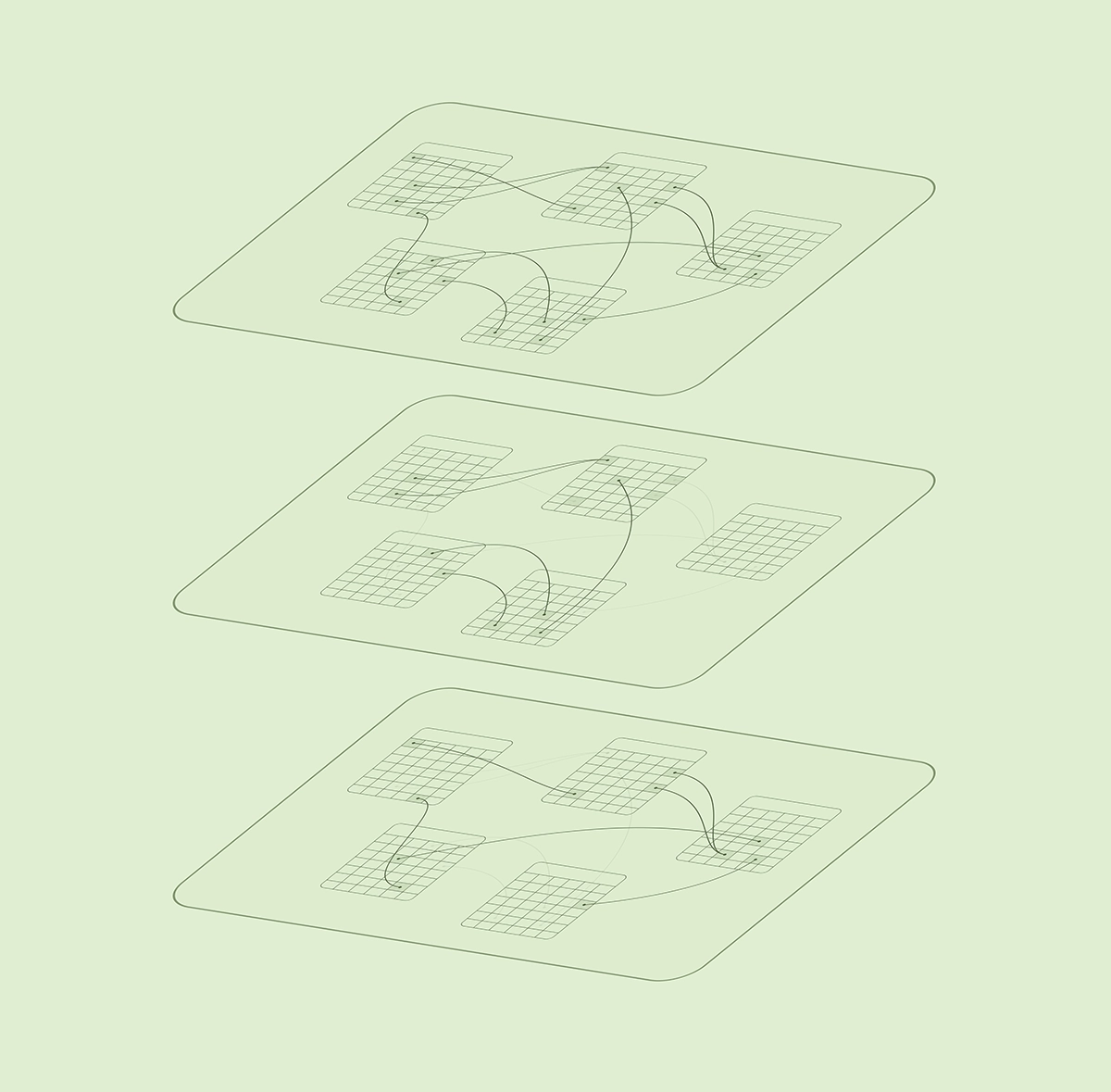
A profound structural advantage of Landfall’s architecture is its ability to serve as a compact representation of multiple knowledge graphs simultaneously. In traditional knowledge graphs, each physical node represents a single, rigid entity. If an organization needs to represent different relationship structures or view the same data through different business rules, it must structurally modify the graph database or manually create duplicate nodes and edges.
In Landfall’s Tabular Knowledge Graph, each node is a table, i.e., a dataset that semantically represents one or more entities, but in practice holds thousands or millions of instances of these entities. Thus the actual knowledge graph can be dynamically induced over these tables. And because a single collection of datasets can be connected in many ways, applying different link selections instantly yields entirely different knowledge graphs (sub-graphs). No copying, moving, or restructuring the underlying data. Different tasks call for different semantic lenses, and Landfall allows organizations to instantiate these lenses on demand over a single, static data substrate.
Traversal
Search is Walking a Sub-graph to Gather Context
Because relationships are first-class, gathering context for a user or agent query is transformed from a probabilistic similarity search into a deterministic graph walk. When a query is executed against a Tabular Knowledge Graph, the engine resolves the starting point to a specific dataset, which may have specific filters applied to isolate a set of rows or cells. From this initial set of entities, the engine traverses the designated cell-to-cell links into neighboring tables, and dynamically assembles a compact, but relationally complete sub-graph that is delivered directly to the model’s context window. This eliminates token waste, as the agent only receives the precise, interconnected nodes required for the task.
Operating Model. From Enterprise Data to Governed Context
Life-cycle
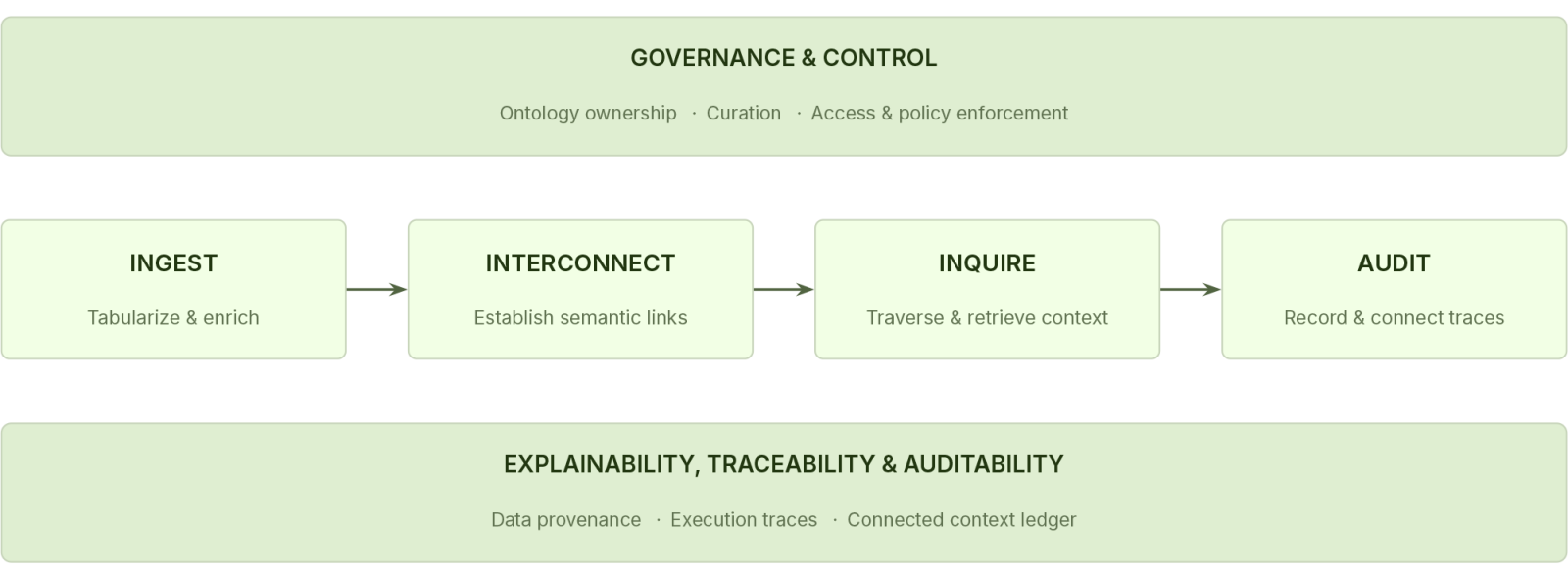
To operationalize Tabular Knowledge Graphs in the enterprise, Landfall structures data management into a four-stage pipeline: Ingest, Interconnect, Inquire, and Audit. This unified pipeline ensures that raw inputs are converted into a structured, connected, and completely auditable enterprise knowledge base.
The stages
1. Ingest (The Tabularization and Enrichment Substrate)
Ingestion handles a wide range of enterprise data sources. Raw, unstructured, or semi-structured documents (such as technical PDFs, invoices, manuals, and images) pass through inference pipelines that parse the inputs, clean anomalous characters, resolve contradictions, and extract and enrich the content. The result is clean, structured tables.
Existing databases and data warehouses are already tabular, so Landfall’s native connectors mount their tables directly into the substrate.
Tables from either route can then pass through a last-mile ETL step on the platform itself (further cleaning, transformation, enrichment, and aggregation) before moving on to the Interconnect stage.
2. Interconnect (Tabular Knowledge Graph Mapping)
The core stage of Landfall’s technology. It automatically establishes the cell-to-cell logical links between the ingested, tabularized datasets, as detailed earlier in this paper, resolving the cold-start problem while keeping the operator in control through the Landfall connection review loop.
3. Inquire (Deterministic Multi-Hop Traversals)
Agents can smoothly query the Tabular Knowledge Graph, fanning out through multiple hops (e.g., jumping from Ingredients → Formulas → Products → Customer Complaints) without losing state. Crucially, Landfall deploys a context-aware reasoning agent that makes this capability accessible without knowledge of the query language, whether to a human user or an external agent system. The agent matches its effort to the question. A straightforward request is translated directly into a query, while a harder or open-ended one is worked as a problem: the agent plans the steps required, asks follow-up questions where the request is ambiguous, decides which traversals to run, and synthesizes the results into an answer. The agent’s response may be read directly by a person or an agent, or consumed by a larger system that makes requests to Landfall systematically, for instance to keep reports up to date, to power a customer-facing chat agent, or to ground the decisions and actions of an agentic workflow.
Note: Landfall’s proprietary query compiler, which the reasoning agent leverages at query time, is a core patent-pending technology, designed to generate deterministic code-like queries that ensure 100% execution accuracy on compact, cost-effective language models.
4. Audit (Full Traceability and the Context Ledger)
Every step of an agent’s traversal across the Tabular Knowledge Graph is immutably recorded as a decision trace. This provides complete bidirectional traceability from any generated output back to its specific database cell coordinates and original source document pages. Furthermore, Landfall can re-ingest these execution logs and decision traces back into a context graph of their own, converting audit history into an active, queryable asset for continuous organizational intelligence.
Enterprise Governance. Keeping Business Semantics under Human Control
Review Loop
A long-standing bottleneck of classical knowledge graphs is the “modeling cold-start”, that is, one has to fully model an ontology by hand before data can be linked. Landfall bypasses this with a connection agent that proposes the links automatically and an interactive curation interface for reviewing them.
Once tables are established, Landfall’s AI agent automatically analyses cell values using several kinds of matching (including exact, fuzzy, vector, and geographic) and curates the results into proposed semantic links. These proposals are always the starting point; how far the user then steps in depends on need and preference. The agent can establish and save the ontology entirely on its own, or users can review its proposals in the Curation Explorer, adding, removing, and editing links with simple clicks, as lightly or as thoroughly as they choose. This keeps the business logic transparent and verifiable.
Pruning in practice
Consider a real-world example: during match generation, the system might find that a product’s natural ID, say 2025, also appears throughout a set of contracts, where it is simply the year they were signed. While an automated matching algorithm might flag this as a potential relationship, a human expert or a context-aware AI agent can instantly recognize it as a coincidence.
Landfall resolves this with an ontology curation agent that assists the user while leaving them in full control. In the Curation Explorer, a user can view the active ontology, inspect the rationale behind any link, and override or refine connections. The process is as simple as reviewing formulas in a spreadsheet and matches how people already think about data. Non-technical business experts remain the final arbiters of business judgment without having to learn a graph query language, which keeps the ontology lightweight, flexible, and trusted.
Explainability and Traceability. The Connected Context Ledger
Explainability
In high-stakes and regulated environments, autonomous AI agents cannot operate as black boxes. If an agent proposes an operational decision, business users must have complete visibility into its reasoning. Landfall addresses this fundamental requirement by providing explainability at two levels:
- Agent Explainability: Users can inspect the plan the agent generated and drill into each step of the execution sequence to see what queries were formulated, what data was retrieved, and how the final recommendation was synthesized.
- Query Explainability: For any query executed against the Tabular Knowledge Graph, users can inspect the full traversal history: where the engine started (the initial dataset and active filters), which semantic links it followed, and which rows and cells it reached.
Verifiability & Traceability
An AI decision is only as trustworthy as its verifiable lineage. Baseline RAG and GraphRAG probabilistically retrieve text fragments or generated community summaries with no deterministic links to the underlying database records, so their answers cannot be verified.
Landfall grounds every answer in the cell-level data retrieved at each execution step, and business users can inspect the exact sub-graph used to construct any response. For datasets extracted from unstructured sources (such as technical PDFs, contracts, or manuals), ingestion metadata traces each extracted value back to its original document, page, and pixel coordinates, providing proof of provenance.
Context Ledger
Agent behaviors, decisions, and execution logs are not left as static text records or isolated log files. Instead, Landfall can re-ingest these behaviors and decision logs back into a context graph of their own.
Converted into graph nodes and links, this context ledger is connected directly to the operational data it refers to. Agent behavior becomes queryable, indexable, and auditable through the same interface as the data itself.
Unlocking Enterprise Autonomy. The Roadmap to True Grounding
The paradigm shift
The transition from passive chat-bots to autonomous agentic workforces is a shift in context architecture, not in model size. Organizations that continue to ground their agents in flat vector clouds or rigid database migrations will face escalating query costs, operational hallucinations, and governance failures.
By superimposing dynamic, cell-level semantic relationships over standard operational tables, Landfall’s Tabular Knowledge Graph technology provides the high-fidelity, scale-ready substrate that modern enterprises require. It delivers grounded and hallucination-free agent performance, bidirectional explainability, and low-friction oversight by non-technical business users.
Taking action
Moving to a grounded agent context layer does not require a disruptive data overhaul. Landfall works with an enterprise’s existing data stack: database tables are mounted in place, and document repositories are tabularized through automated inference pipelines.
Organizations interested in evaluating Landfall’s Tabular Knowledge Graph platform on their own data are invited to contact the team.
Protected by U.S. Patent No. 12,743,441